India Finally Has Its Own Interior Trend Report. Here Is Why That Matters?
For as long as the organized Indian home interior industry has existed, its practitioners have operated without a structured intelligence document of their own. Designers specified surfaces by instinct and exhibition exposure. Traders stocked products based on dealer relationships and last season’s demand. OEMs made production mix decisions by reading signals from distributors rather than from documented market data. Brands launched collections calibrated to European trend reports written for different climates, different cooking cultures and different household structures entirely.
This is not a criticism. It is simply the reality of a market that grew fast and organically, without the research infrastructure that its scale now demands. The India organized home interior market reached an estimated INR 35,000 crore in OEM pool value in FY 2024-25. It is projected to reach INR 61,700 crore by 2030. A market of this consequence deserves intelligence of this depth. Until now, it did not have it.
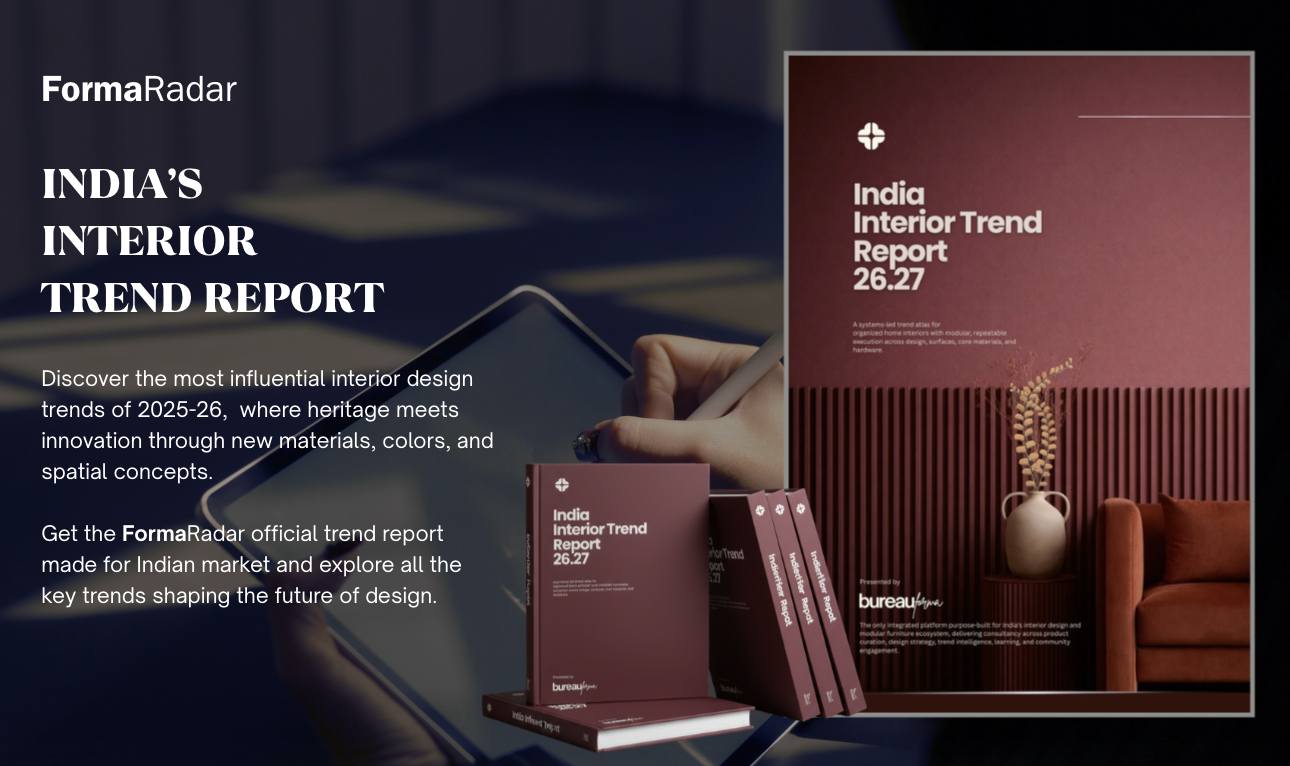
The India Interior Trend Report 2026-27, published by Bureau Forma Radar and launched at the India Kitchen Congress, is the first structured, specification-grade market intelligence document built entirely for India’s organized home interior ecosystem. Twelve chapters. 120 plus exhibits. Primary field research across 500 plus professionals, 9 cities, 4 regions and 3 tiers. Not a mood board. Not a product catalogue. Not a macro-economic overview. A systems-led trend atlas built for the practitioners, producers and strategists who build, specify, sell and design organized interior products for Indian households.
Why India needed this now
The Indian kitchen is the most demanding kitchen environment in the world. EN438, the European standard that most surface manufacturers use to certify their products, does not test for haldi exposure, pressure cooker steam at 110 to 120 degrees Celsius or the commercial degreasers used in Indian daily cleaning. The Indian user stands at 5 feet 4 inches on average — eight to ten centimetres shorter than the European reference height embedded in every counter height, every wall unit depth and every ergonomic dimension in the global modular furniture catalogue. The Indian wardrobe carries sarees. The Indian kitchen stores sixty spice containers. The Indian home has a puja zone that no international furniture system catalogues as a standard product.
These are not minor variations from a global norm. They are structural differences that require structural intelligence. Intelligence that only an India-first report, built on India-specific research, can provide.
What the report delivers
The IITR-2627 is organized around four intelligence verticals. Consumer and demand intelligence maps who the Indian household is, how it decides and where the market is growing. Design and surface intelligence documents where the organized market is specifying today and where it is heading through 2030. Structural and material intelligence establishes the substrate and hardware systems that determine whether a specification holds under Indian conditions. Commercial and strategic intelligence provides the market sizing, structural shifts and stakeholder playbooks that orient every commercial decision through 2030.
The report introduces six composite indices — the ISTI, DMI, STI, CAS, HAS and SCI — diagnostic benchmarks that allow any practitioner to assess specification quality, market position and commercial readiness against the India market standard. It documents ten household archetypes, six project decision personas, seven surface families rated against Indian conditions, nine structural substrate categories with zone-based guidance and a complete hardware specification registry covering motion systems, finishes, accessories and lighting.
What it means for the ecosystem
The designer who reads Chapter 6 understands their client before the first meeting. The trader who reads Chapter 9 has a zone specification matrix they can put in front of every designer who walks into their showroom. The OEM who reads Chapter 10 has a substrate selection framework calibrated to Indian climate zones and Indian use conditions. The brand that reads Chapter 12 has a 2030 scenario model built on confirmed structural forces, not aspirational projections.
The organized Indian interior market is entering its most commercially significant decade. 148 million new middle-class households will make their first or second organized interior specification decision in the next five years. The renovation wave from 2008 to 2016 Phase 2 installations is creating the most commercially predictable demand pool the market has ever seen. Tier 2 cities are on the verge of becoming the market’s largest growth engine.
The decisions being made today — about what to specify, what to stock, what to produce, what to position — will determine who leads that market and who follows it.
The India Interior Trend Report exists to make those decisions better.
Download or subscribe to IITR-2627 at www.bureauforma.com | Contact: admin@bureauforma.com